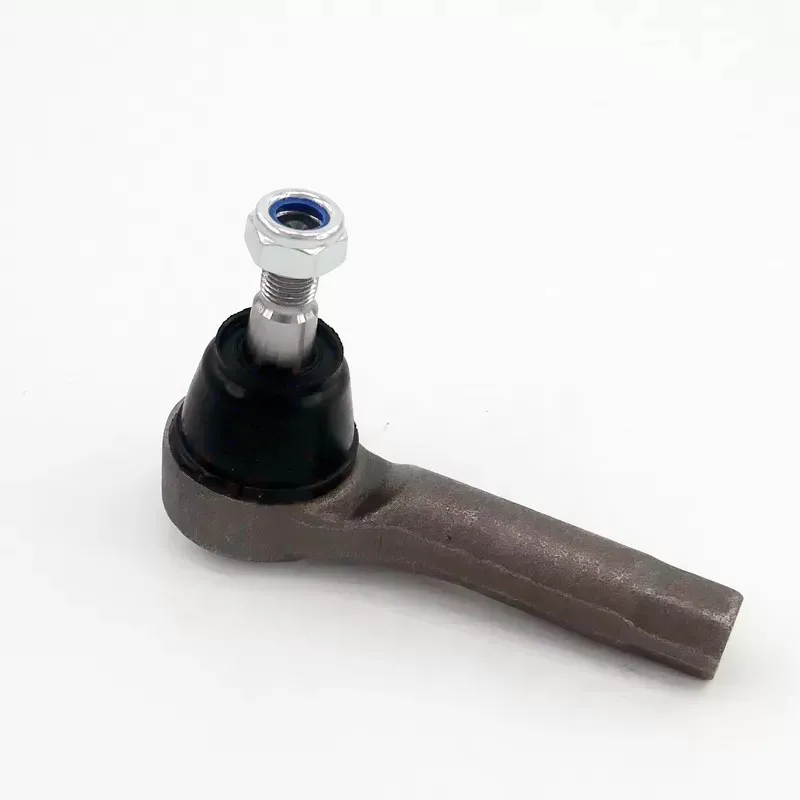
When I diagnose What Causes Tie Rod End Ball Stud Looseness?, I begin with five major possibilities: internal socket wear, contamination after dust-boot damage, impact loading, corrosion, and incorrect installation. A loose tie rod end can create steering wander, vibration, front-end clunking, uneven tire wear, and delayed steering response. The condition may come from the ball-and-socket joint itself, but it can also result from a loose tapered stud, incorrect castle-nut torque, a missing cotter pin, a damaged steering-arm hole, or a bent tie rod. Correct diagnosis matters because these faults do not have the same repair.
A tie rod end connects the steering linkage to the steering knuckle or steering arm. It allows the wheel to turn left and right while accommodating suspension movement, so the joint must pivot without permitting excessive radial or axial movement. When the ball stud or socket loses its intended preload, the wheel can change toe angle under braking, acceleration, or cornering. I treat measurable play in this joint as a steering-system fault rather than a normal suspension characteristic.
!
How the Tie Rod End Works in the Steering System
The steering wheel turns the steering shaft, rack, or steering gear, which moves the inner tie rod and outer tie rod end. The outer joint uses a tapered ball stud to locate the steering knuckle while allowing angular movement between the linkage and wheel assembly. On many vehicles, the inner tie rod uses a similar ball-and-socket arrangement inside or near the steering rack. Both joints affect steering response and the front-wheel toe setting.
The ball stud is normally held inside a socket by a bearing surface, spring, cap, or other preload system defined by the component design. A flexible dust boot keeps water, road grit, and salt away from the contact surfaces while retaining lubricant. If the boot tears or the joint loses preload, contaminants can enter and the ball can develop clearance inside the socket. That clearance may begin as a small movement but can increase as the contact surfaces wear.
What Causes Tie Rod End Ball Stud Looseness?
The most common causes are internal ball-and-socket wear, boot failure, corrosion, impact damage, and installation faults. I separate these causes from a loose taper because the ball stud may be tight inside the socket while the tapered mounting connection is moving in the steering arm. The following distinctions help prevent replacing the wrong part or overlooking a safety-critical fastening problem.
Internal Ball-and-Socket Wear
Internal wear occurs when the ball stud and socket lose material or the joint’s preload decreases. Repeated steering loads, road vibration, high mileage, and contamination can enlarge the effective clearance between the two surfaces. A worn tie rod end socket may allow the stud to move vertically, horizontally, or in several directions when the wheel is loaded.
The mechanical progression often begins with lubricant loss or a damaged boot. Water and abrasive particles then reach the bearing surfaces, increasing friction and removing protective material during steering movement. As the socket wears, the joint develops measurable play, and the wheel may shift enough to alter toe during normal driving.
Damaged Dust Boot and Contamination
A torn, split, or displaced dust boot is one of the clearest early warning signs. The boot does not normally create looseness by itself, but it removes the barrier that protects the joint from water, mud, and road salt. Once contamination reaches the ball-and-socket interface, corrosion and abrasive wear can accelerate.
I inspect the boot for cracks around the neck, missing clamps, grease leakage, and contact marks from nearby components. A joint with a recently damaged boot may not yet show measurable play, but the correct repair depends on the manufacturer’s service procedure and the joint’s design. Many sealed joints require replacement rather than boot-only service when contamination has already entered the socket.
Corrosion and Loss of Lubrication
Corrosion can develop on the ball stud, socket, spring, cap, or other internal surfaces. Vehicles used in regions with winter salt, coastal moisture, standing water, or frequent mud exposure face greater contamination risk, although corrosion can occur anywhere after boot damage. Lubrication failure increases friction and may accelerate surface damage during steering articulation.
A greaseable design requires the correct lubricant and service interval, while a sealed design must retain its factory lubricant through the service life of the joint. I do not add grease through a damaged boot or assume that lubrication will restore a joint that already has measurable clearance. Once metal surfaces have worn or rusted, lubrication cannot rebuild the original bearing geometry.
Pothole, Curb, and Collision Damage
A pothole or curb strike can impose a high side load on the steering linkage. The impact may damage the ball stud, distort the socket, bend the tie rod, deform the steering arm, or loosen the tapered connection. A sudden steering pull, new vibration, or change in steering-wheel position after an impact requires inspection even if the tire remains inflated.
Impact damage can also produce a look-alike fault. For example, a bent tie rod may alter toe without creating ball-stud play, while a damaged steering-arm hole may prevent the tapered stud from seating correctly. I inspect the entire linkage instead of assuming that every post-impact symptom comes from a worn outer tie rod end.
Loose Taper, Nut, or Cotter Pin
A tie rod end ball stud can feel loose because the tapered mounting connection is not clamped correctly. Possible causes include incorrect nut torque, a reused damaged nut, a missing or improperly installed cotter pin, dirt between the taper and steering-arm bore, or a stud that was not fully seated. This is different from internal socket wear because the movement occurs at the mounting interface.
The castle nut must be tightened to the vehicle manufacturer’s specified torque and secured according to the service manual. I do not remove material from a nut, taper, or steering arm to force alignment, and I do not substitute a generic fastener without confirming thread, locking method, and strength requirements. If the cotter-pin hole does not align at the specified torque, the manufacturer’s instructions determine the correct procedure.
Damaged Steering-Arm Hole or Bent Tie Rod
A worn, oval, cracked, or damaged steering-arm hole can prevent the tapered stud from locking securely. The stud may appear to move even though the ball-and-socket joint has acceptable internal clearance. A bent tie rod can produce toe misalignment, steering-wheel offset, or uneven tire wear without the same type of vertical play found in a worn socket.
I compare the suspected side with the opposite side, inspect the taper and bore for fretting marks, and look for fresh metal movement around the nut. Any crack in the steering arm, distorted mounting hole, or visibly bent steering component requires repair according to the vehicle manufacturer’s procedure. Replacing only the tie rod end may not correct a damaged mounting structure.
Symptoms of a Loose Tie Rod End Ball Stud
The most common tie rod end symptoms involve steering control, noise, and tire wear. A driver may report loose steering, wandering, a delayed response after turning the wheel, or a vehicle that requires constant correction on a straight road. Some vehicles produce a clunk when the steering direction changes or when the wheel moves over uneven pavement.
Vibration can occur when looseness allows the wheel angle to change under load, although tire imbalance, wheel damage, bent rims, wheel-bearing play, and brake faults can cause similar sensations. Uneven or feathered front-tire wear may indicate changing toe, but alignment must be measured before assigning the cause to a tie rod end. I treat symptoms as evidence for inspection, not as a substitute for measuring joint movement and alignment.
| Symptom |
Possible tie rod connection |
Look-alike causes to check |
| Steering wander or delayed response |
Ball-socket play, loose taper, bent linkage |
Tire pressure, alignment, worn control-arm bushing |
| Front-end clunk |
Joint movement under load |
Stabilizer link, ball joint, strut mount |
| Steering vibration |
Toe change or damaged linkage |
Wheel imbalance, bent rim, wheel bearing |
| Uneven tire wear |
Incorrect or changing toe |
Alignment, tire inflation, worn suspension parts |
| Pull after pothole impact |
Bent tie rod or damaged taper |
Tire damage, control arm, steering knuckle |
How to Inspect Tie Rod End Ball Stud Looseness
Before inspection, I use a level surface, apply the parking brake, chock the wheels, and follow the vehicle’s approved lifting points. I support the vehicle with correctly rated stands rather than relying only on a jack. The inspection method varies by suspension design, so I follow the service manual when it specifies a loaded or unloaded joint check.
Visual Inspection
I first examine the dust boot, retaining rings, grease condition, stud, nut, cotter pin, steering-arm bore, and tie-rod shaft. I look for torn rubber, displaced boots, rust dust, shiny fretting marks, impact bends, missing hardware, or evidence that the nut has moved. A visual inspection cannot prove that a joint has no play, but it can identify conditions that require immediate disassembly or replacement.
Checking for Play
To check tie rod end play, I keep my hands clear of pinch points and observe the joint while an assistant moves the steering wheel through a small range. I watch the stud, housing, and steering arm together to identify where movement originates. Movement between the ball stud and housing suggests internal socket play, while movement between the stud taper and steering arm suggests a mounting fault.
Some technicians also check the tire at the 3-and-9 o’clock positions, but that test can include inner tie rod, outer tie rod, steering rack, wheel bearing, and other linkage movement. I isolate each joint with a suitable pry tool only where the service procedure permits it. The acceptable play limit must come from the vehicle or component manufacturer; I do not apply one universal millimeter value to every tie rod design.
Diagnostic Decision Tree
I use the following sequence to separate common causes:
- Is the dust boot torn or displaced? If yes, inspect for contamination, corrosion, and measurable play rather than replacing the boot automatically.
- Does the ball stud move inside the housing? If yes, suspect internal socket wear or preload loss.
- Does the stud move at the steering-arm taper? If yes, inspect torque, seating, cotter-pin installation, taper condition, and steering-arm bore.
- Is the rod bent or the steering arm damaged? If yes, correct the structural or linkage fault before alignment.
- Are there no tie rod faults? Check ball joints, control-arm bushings, wheel bearings, strut mounts, tires, wheels, and rack mounts.
- Does the measured play exceed the manufacturer’s limit? Replace the affected component using the specified hardware and torque procedure.
Is It Safe to Drive With a Loose Tie Rod End?
I do not recommend driving when a tie rod end has confirmed excessive play, a loose tapered connection, a missing retaining pin, a cracked steering arm, or a visibly damaged stud. These conditions can worsen under braking, cornering, pothole impact, or emergency steering. If the joint is close to separation, the affected wheel can lose normal steering control.
A vehicle should be transported for repair when the steering wheel has excessive free movement, the wheel visibly shifts during inspection, the joint produces severe clunking, the stud or nut is not retained, or the vehicle changes direction unpredictably. A short drive to a repair facility is not automatically safe simply because the vehicle still responds to steering input. I base the decision on inspection findings, not on whether the noise seems minor.
Repair and Replacement Considerations
A loose tie rod end is normally repaired by replacing the affected joint or correcting the mounting fault. I record the original exposed thread length or count turns only as an installation aid, because those methods do not replace a final four-wheel alignment. After replacement, the technician should verify fastener torque, cotter-pin or locking hardware installation, boot position, steering movement, and toe alignment.
When selecting a replacement tie rod end, I match the vehicle application, side, thread direction, stud dimensions, taper, boot design, grease configuration, and required hardware. I also compare the supplier’s inspection records, material specifications, corrosion controls, and test documentation instead of relying only on brand familiarity. For fleet or wholesale purchasing, part-number accuracy, batch traceability, packaging, minimum order quantity, and replacement support can affect total cost more than the unit price.
Zegao Machinery manufactures chassis components including Tie Rod End, ball joints, control arms, rack ends, stabilizer links, and other suspension parts. The company states that it was established in 1995 and operates from a facility totaling 5,000 square meters, with more than 3,000 square meters of construction area. Its published company information lists fixed assets of 30 million yuan, working capital of 20 million yuan, and annual output value of 60 million yuan.
For a replacement evaluation, I would ask Zegao Machinery or any supplier for the exact application list, dimensional drawings, stud and thread specifications, torque guidance, boot material information, inspection records, and warranty terms. The supplier’s published product range includes tie rod ends for specific vehicle applications, but the correct part still depends on the vehicle identification number, axle position, steering design, and regional specification. A correct comparison must verify fitment before comparing price or package quantity.
Conclusion
What Causes Tie Rod End Ball Stud Looseness? In most cases, the cause is internal socket wear, contamination after boot failure, corrosion, impact loading, preload loss, a loose tapered connection, incorrect castle-nut torque, damaged retaining hardware, or a deformed steering-arm mounting surface. I diagnose the condition by separating ball-and-socket movement from taper movement and by checking the complete steering linkage for bent or damaged parts.
The next actions are straightforward: inspect the dust boot and hardware, check the joint under the manufacturer’s specified conditions, compare measured play with the applicable service limit, and stop driving if the joint is severely loose or poorly retained. Replace the failed component with a correctly matched Tie Rod End, install the required locking hardware, torque it to specification, and complete a wheel alignment. These steps address both the immediate steering risk and the alignment changes that can cause uneven tire wear.


 es
 cn