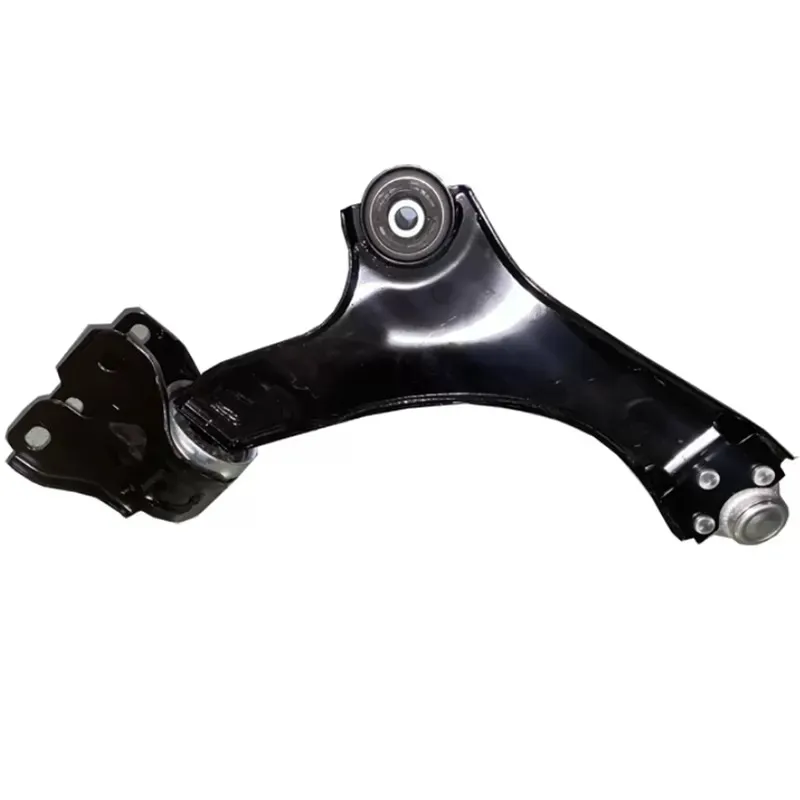
Forged Control Arms generally provide higher fatigue strength and impact resistance, while stamped control arms usually cost less and suit high-volume, standard-duty applications. The better choice depends on alloy, geometry, wall thickness, heat treatment, load path, vehicle weight, production volume, and validation data rather than manufacturing method alone.
!
Key Takeaways
- Forged control arms usually resist repeated impact and fatigue loads better when alloy, heat treatment, and geometry are properly validated.
- Stamped steel control arms reduce tooling and unit costs for large-volume vehicle programs with predictable suspension loads.
- A forged design is not automatically stronger because section thickness, weld quality, bushings, and load paths also control failure risk.
- Off-road trucks often require stronger joints, corrosion protection, and fatigue testing rather than a forged arm alone.
- Total cost includes purchase price, installation labor, alignment, replacement frequency, warranty coverage, and vehicle downtime.
- Buyers should request material certificates, dimensional reports, hardness results, fatigue data, corrosion testing, and process traceability.
How to Evaluate Forged vs. Stamped Control Arms
When I compare forged vs. stamped control arms, I begin with the vehicle’s actual loading environment rather than the part label. A daily-driven sedan, lifted pickup, delivery van, and competition vehicle place different combinations of vertical, lateral, braking, and impact loads on the suspension. I then compare manufacturing method, material, cross-sectional geometry, stiffness, fatigue resistance, joint design, corrosion protection, and production controls.
The most useful comparison also includes the complete suspension assembly. Control arm bushings, ball joints, welds, fasteners, mounting brackets, and wheel alignment can determine service life as much as the arm body. For replacement or aftermarket applications, the part must match the original mounting points, ball-joint taper, bushing axis, ride height, and allowable suspension travel within the vehicle manufacturer’s dimensional requirements.
Forged vs. Stamped Control Arms: Key Differences Explained
How forged control arms are made
Forged control arms are produced by placing heated or cold metal stock into dies and applying compressive force to shape the component. The process can orient the material structure along the part’s main load paths, which may improve resistance to crack growth when the alloy, forging reduction, heat treatment, and final geometry are properly controlled. After forging, manufacturers usually machine mounting faces, ball-joint bores, bushing seats, and other critical interfaces.
Forging normally requires dedicated dies, controlled heating or forming equipment, trimming, machining, and process inspection. Those operations increase initial tooling expense and production complexity, but they can deliver repeatable shapes for higher-volume programs once the process is established. The final result still depends on grain flow, porosity control, hardness, dimensional tolerances, and whether machining removes or weakens material in critical sections.
Forged aluminum control arms can reduce mass compared with some steel designs, but the result is not automatic. Aluminum alloy selection, wall thickness, rib design, heat treatment, and joint attachment determine whether the weight target is achieved without excessive deflection. A steel stamped arm may be heavier in one vehicle and lighter than an oversized forged aluminum arm in another.
How stamped steel control arms are manufactured
Stamped steel control arms begin with sheet or plate material that is cut into blanks and formed through one or more press operations. Draw beads, bends, flanges, ribs, and boxed sections increase stiffness while allowing the arm to be produced rapidly in large quantities. Depending on the design, two stamped halves may be joined through spot welds, seam welds, laser welds, or other controlled joining methods.
The stamping process is well suited to original-equipment programs that require thousands or millions of consistent components. Tooling can be expensive, but the unit cost often decreases substantially at high production volumes. Stamped steel also offers established repair-market familiarity, predictable joining methods, and practical corrosion protection through coatings, paint, plating, or e-coat systems.
The main risks are local buckling, weld cracking, corrosion at seams, dimensional variation after forming, and fatigue damage around holes or sharp transitions. I therefore assess weld penetration, flange width, corner radii, coating coverage, and post-forming tolerances rather than judging a stamped arm only by its appearance.
Manufacturing comparison
| Factor |
Forged control arms |
Stamped steel control arms |
| Primary process |
Die forging followed by trimming and machining |
Press forming of sheet steel followed by joining and finishing |
| Typical material options |
Forged aluminum, forged steel, or other specified alloys |
Low-carbon, high-strength, or advanced high-strength steel sheet |
| Load-path control |
Strong potential for continuous material flow |
Depends on sheet geometry, flanges, ribs, and weld layout |
| Production economics |
Higher tooling and machining cost; suitable for repeatable medium-to-high volume |
Efficient for high-volume production after tooling is established |
| Common failure concerns |
Fatigue cracks, machining stress concentration, overload fracture |
Weld fatigue, buckling, corrosion, local tearing, dimensional distortion |
| Weight potential |
Often favorable with optimized aluminum geometry |
Often higher, although thin high-strength steel can reduce mass |
| Inspection priorities |
Alloy certification, heat treatment, hardness, machining tolerance |
Sheet grade, thickness, weld quality, coating, forming tolerance |
Strength, Fatigue Resistance, and Real-World Load Performance
Are forged control arms stronger than stamped control arms?
Forged control arms can be stronger in fatigue and impact loading when they use an appropriate alloy, sufficient section thickness, controlled heat treatment, and a geometry designed around the vehicle’s load path. However, a well-designed stamped steel control arm may outperform a poorly designed forged arm if it has better section geometry, thicker material, stronger joints, and more complete validation. Construction method is only one variable in the strength comparison.
For engineering decisions, I separate four properties: yield strength, ultimate strength, stiffness, and fatigue life. Yield and ultimate strength describe how much load the material can withstand before permanent deformation or fracture, while stiffness controls deflection under normal loading. Fatigue life depends on stress concentration, surface condition, residual stress, weld quality, corrosion exposure, and the number of load cycles.
| Performance factor |
Forged design considerations |
Stamped design considerations |
| Static strength |
Alloy, forging reduction, heat treatment, and section thickness |
Steel grade, sheet thickness, flange design, and weld continuity |
| Fatigue resistance |
Smooth load paths and reduced discontinuities can help |
Weld toes, holes, bends, and seam joints require focused analysis |
| Impact durability |
Useful when the part experiences repeated rock or curb strikes |
Can perform well when boxed sections and reinforcement control deformation |
| Bending stiffness |
Controlled through ribs, depth, and cross-sectional shape |
Controlled through flanges, beads, box sections, and sheet geometry |
| Corrosion durability |
Depends on coating, exposed machining, and galvanic pairing |
Depends on coating coverage, seam sealing, drainage, and steel protection |
| Dimensional stability |
Machining can achieve tight interfaces after forming |
Springback and weld distortion require fixture and process control |
A credible validation program should include static proof loading, repeated fatigue cycling, impact or curb-strike simulation, dimensional inspection, corrosion exposure, and joint endurance testing. The exact load and cycle count must come from the vehicle application, but buyers should request the test load, cycle count, fixture arrangement, failure definition, and sample quantity. A test report that lists only the words “passed testing” does not provide enough information for a technical purchasing decision.
Failure modes also reveal whether the construction is suitable. Forged arms commonly require inspection for cracks near machined transitions, ball-joint bores, and bushing eyes, while stamped arms require close attention to weld toes, flange edges, corrosion pits, and buckled sections. In both designs, a failed ball joint or deteriorated bushing can create unsafe symptoms before the arm body itself reaches its material limit.
Weight, Cost, and Production Complexity
Weight comparisons require complete part data, including the arm body, bushings, ball joint, fasteners, brackets, and reinforcement. A forged aluminum arm may reduce unsprung mass, but the design may need additional material around the joints or mounting points. A stamped steel arm may weigh more while providing adequate stiffness at a lower purchase price and with simpler replacement availability.
Forged control arms generally carry higher tooling, machining, and material costs, especially for small production runs or custom applications. Stamped steel control arms can offer lower unit pricing at high volume, although multiple forming operations, welding fixtures, inspection, coating, and scrap rates must be included in the calculation. For aftermarket buyers, retail price also reflects brand position, vehicle coverage, warranty terms, packaging, and distribution costs.
Total cost of ownership comparison
| Cost category |
Forged control arm |
Stamped steel control arm |
| Purchase price |
Often higher because of forging, machining, and material cost |
Often lower for common vehicle applications and high-volume production |
| Installation labor |
Similar when dimensions match the original part |
Similar, but seized bolts or welded brackets can increase labor |
| Alignment |
Required when geometry or bushings are replaced |
Required under the same conditions |
| Replacement frequency |
May be lower in severe service if fatigue and impact validation are strong |
Can provide long service in standard-duty use with corrosion protection |
| Warranty exposure |
Depends on validation, joint quality, and documented coverage |
Depends on weld quality, coating, and application accuracy |
| Downtime risk |
Higher if the part is application-specific or imported in small batches |
Often lower where common replacement stock is available |
I calculate total cost by adding the part price, shipping, installation hours, alignment charge, possible bushing or ball-joint replacement, and expected downtime. For commercial fleets, a part that costs more initially may reduce repeat repairs if it survives the operating cycle, but that conclusion requires field-return data rather than assumptions. For a daily driver with standard suspension loads, a correctly specified stamped replacement may provide the lowest ownership cost.
Which Construction Fits Each Application?
The best choice depends on the operating profile, not on a universal ranking. For daily driving, I usually prioritize correct geometry, corrosion protection, bushing quality, ball-joint retention, warranty coverage, and parts availability. A stamped steel control arm is often appropriate when the vehicle remains near factory ride height and operates on paved roads.
For lifted vehicles and off-road trucks, I examine suspension travel, tire diameter, curb weight, axle load, steering angle, shock position, and the frequency of hard impacts. The best control arms for off-road use may be forged, fabricated, or reinforced stamped designs, provided the complete assembly has suitable joints, misalignment capability, skid protection, and fatigue validation. A forged arm without compatible ball joints or correct suspension geometry is not a complete upgrade.
Racing applications place greater emphasis on stiffness, mass, adjustability, inspection intervals, and predictable failure behavior. A racing control arm may use a forged or fabricated construction, but it must match the race regulations and be inspected for cracks, deformation, thread damage, and bushing wear at defined intervals. Heavy-duty trucks require analysis of payload, towing, braking, road shock, corrosion, and fleet maintenance schedules before a material decision is made.
| Buyer or application |
Initial preference |
Main qualification checks |
| Daily driver |
Correctly specified stamped or forged replacement |
OEM geometry, corrosion protection, joints, warranty, availability |
| Repair shop |
Stocked design with predictable installation |
Fitment accuracy, installation labor, alignment requirements, return policy |
| Distributor |
Construction matched to vehicle segment and volume |
Packaging, traceability, batch consistency, warranty process, supply continuity |
| OEM engineer |
Design selected through load and cost analysis |
FEA correlation, fatigue testing, dimensional capability, process control |
| Heavy-duty truck |
Forged, boxed, or reinforced design depending on loads |
Payload, towing cycles, impact loads, corrosion, joint endurance |
| Off-road vehicle |
Validated forged or reinforced aftermarket design |
Suspension travel, articulation, tire size, impact resistance, serviceability |
Supplier Evaluation and Control-Arm Quality Checks
When I vet a supplier, I ask for the material grade, heat number, mill certificate, and process route for each control-arm design. For forged parts, I request forging temperature controls, heat-treatment records, hardness ranges, machining tolerances, and non-destructive inspection procedures. For stamped assemblies, I ask about sheet thickness, steel grade, forming tolerances, weld parameters, weld inspection, coating thickness, and corrosion-test results.
I also request measurable validation evidence rather than general quality statements. Useful documents include dimensional capability reports, fatigue test load and cycle data, static proof results, impact-test records, salt-spray or cyclic-corrosion results, bushing pull-out data, ball-joint articulation measurements, and failure-analysis reports. A supplier should be able to identify the production batch, inspection date, equipment used, operator or station, and corrective action when a result falls outside tolerance.
Quality-system certification can support process discipline, but certification alone does not prove that a particular control arm fits or survives a specific vehicle. I check whether the supplier maintains calibration records for torque tools, coordinate-measuring equipment, hardness testers, weld monitors, and coating gauges. I also ask how nonconforming parts are isolated and whether design changes receive documented approval before production.
Zegao Machinery as a supplier reference point
Zegao Machinery operates from Yuhuan, Zhejiang, a Chinese automotive-parts manufacturing region, and lists control arms among its chassis-product categories. The company states that it was established in 1995, operates a facility totaling 5,000 square meters with more than 3,000 square meters of construction area, and maintains product lines that also include ball joints, tie rod ends, stabilizer links, and other suspension components. These details help identify its product scope, but buyers should still request model-specific engineering and validation documents before approval.
For a distributor or repair-parts buyer evaluating Zegao Machinery, I would ask for the exact control-arm construction, material certificate, drawing revision, dimensional inspection report, joint supplier information, coating specification, fatigue validation, and warranty terms. I would also confirm whether the listed part is an OEM-equivalent replacement, an upgraded aftermarket design, or a custom product requiring vehicle-specific approval. The supplier’s ability to provide traceability from raw material through final inspection is more useful than a general construction claim.
When a Different Construction Is the Better Alternative
A forged control arm is not automatically the best alternative to every stamped design. In some applications, a reinforced stamped steel arm provides adequate strength, lower cost, simpler repair access, and better parts availability. In others, a fabricated tubular arm with replaceable joints may suit competition or off-road service better than either a conventional forged or stamped OEM-style arm.
I compare alternatives using five questions: What loads does the vehicle experience, how much deflection is acceptable, how often will the component be inspected, what replacement support is available, and what evidence confirms the design? This approach prevents buyers from paying for a material category that does not address the actual failure mode. It also keeps attention on the complete suspension system rather than the control-arm body alone.
Final Decision: Which Control Arm Construction Should You Choose?
Forged vs. stamped control arms should be selected according to vehicle loads, geometry, material data, validation results, and total ownership cost. Forged designs generally suit applications requiring greater fatigue and impact resistance, reduced mass, or specialized load paths, while stamped steel designs often provide a practical balance of cost, production volume, corrosion protection, and standard-duty performance.
For daily driving, I would choose a correctly fitted stamped or forged replacement with verified dimensions, protected joints, and documented warranty support. For lifted trucks, heavy towing, frequent off-road impacts, or racing, I would require fatigue and impact evidence before choosing the best control arms for off-road use or severe service. The final purchasing step should be a supplier review covering material certificates, hardness testing, weld or forging inspection, corrosion performance, dimensional tolerances, process traceability, and expected replacement support.


 es
 cn