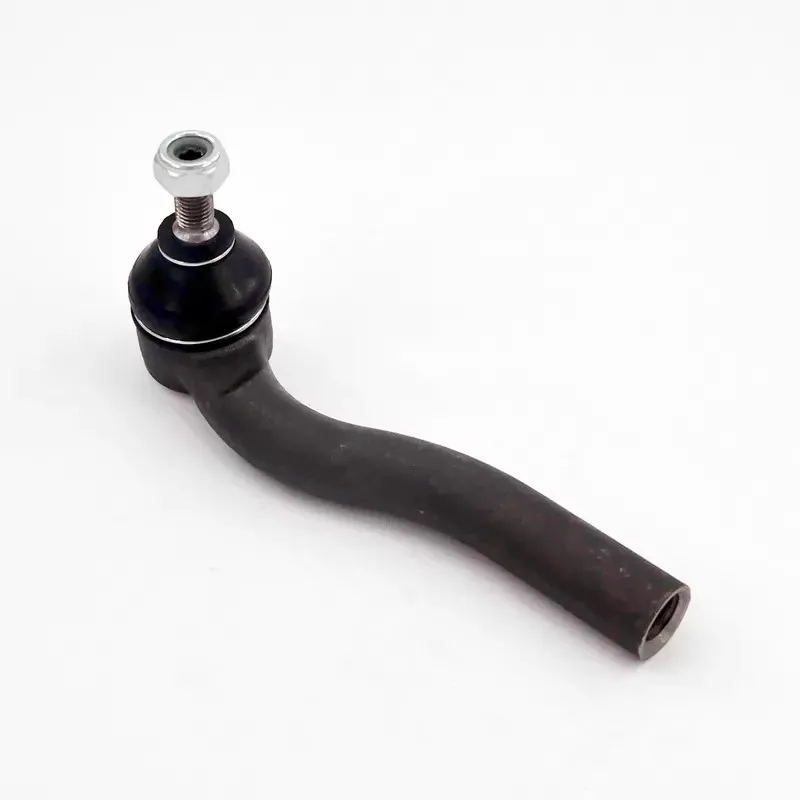
When I compare Forged vs. Cast Tie Rod Ends: Which Is Better for Durability?, I focus on more than the manufacturing label. Forged tie rod ends are generally preferable for fatigue-critical steering applications because controlled deformation can improve grain flow and reduce some casting-related defects. However, a properly engineered cast design can be suitable when the material grade, geometry, heat treatment, dimensional tolerances, sealing system, inspection process, and cost requirements are appropriate.
!
A Tie Rod End transfers steering movement while allowing angular motion between the steering linkage and the wheel assembly. Its service life depends on the complete assembly, including the housing, ball stud, bearing liner, boot, grease or lubrication system, threads, and installation accuracy. In this guide, I compare forged steel tie rod ends and cast steel tie rod ends for daily driving, towing, lifted trucks, modified suspension geometry, and off-road use.
Key Takeaways
- Forged tie rod ends generally provide better fatigue resistance for high steering loads and repeated impact conditions.
- Quality cast steel tie rod ends can suit standard vehicles when geometry, material grade, and inspection controls are adequate.
- Housing design, ball-stud hardness, liner wear, boot sealing, and alignment affect durability as much as manufacturing method.
- Off-road trucks, towing vehicles, and lifted suspensions usually need stronger validation than ordinary daily drivers.
- Buyers should request material certificates, heat-treatment records, dimensional reports, fatigue data, and traceability documentation.
Forged vs. Cast Tie Rod Ends: Key Differences in Durability
Forging shapes heated steel through controlled pressure, while casting forms the component by pouring molten metal into a mold. The two processes create different internal structures, machining requirements, defect risks, and production economics. Neither process automatically guarantees a durable tie rod end because the final result also depends on alloy selection, heat treatment, surface finishing, design loads, and quality control.
| Comparison factor |
Forged steel tie rod ends |
Cast steel tie rod ends |
| Internal structure |
Deformed grain structure can follow major load paths |
Solidified structure depends on mold filling and cooling control |
| Fatigue resistance |
Often favorable for repeated steering and impact loads |
Can be adequate when casting quality and geometry are well controlled |
| Defect risk |
May include laps, folds, or forging cracks if poorly formed |
May include porosity, shrinkage cavities, inclusions, or cold shuts |
| Geometry |
Best suited to load-oriented shapes and high-stress sections |
Offers greater freedom for complex shapes and integrated features |
| Production cost |
Higher tooling and forming investment for some designs |
Often economical for complex or moderate-volume parts |
| Typical use |
Heavy-duty steering, off-road, towing, and severe service |
Standard replacement parts and designs where loads are controlled |
Strength and Fatigue Resistance
A forged component can achieve favorable grain flow because the steel is plastically deformed rather than simply solidified in a mold. When the forging direction, section thickness, radius transitions, and heat treatment are properly controlled, the housing or ball stud may resist repeated tensile, bending, and impact loads more effectively. This advantage matters because steering components experience changing loads rather than one single static force.
Casting is not automatically weak, but the internal structure requires closer process control. Porosity, shrinkage, inclusions, and incomplete filling can reduce the effective load-bearing area and create local stress concentrations. For that reason, I evaluate cast steel tie rod ends through material documentation, non-destructive inspection where applicable, dimensional checks, and fatigue or pullout test results rather than judging them from appearance alone.
Manufacturing, Heat Treatment, and Machining
Forged steel tie rod ends normally require controlled heating, forming, trimming, heat treatment, shot blasting or surface cleaning, and precision machining. Heat treatment must produce a suitable balance between hardness, strength, toughness, and wear resistance. Excessive hardness can reduce impact tolerance, while insufficient hardness may accelerate ball-stud or bearing-surface wear.
Cast steel tie rod ends require mold design, melt chemistry control, pouring-temperature management, solidification control, riser design, fettling, heat treatment, and machining. A casting may reduce machining waste and support complex housing geometry, but it also requires careful control of shrinkage and internal soundness. In both processes, the machined taper, thread, ball-seat dimensions, and stud articulation range must remain within the vehicle or customer specification.
The Complete Assembly Matters
The housing is only one part of a tie rod end. A forged housing paired with a poorly hardened ball stud, an undersized liner, a damaged boot, or inaccurate threads can fail earlier than a well-designed cast assembly. I therefore compare the ball stud material, stud surface hardness, liner material, preload, boot compound, clamp design, grease retention, corrosion protection, and thread accuracy together.
The boot deserves particular attention in muddy, wet, salty, or dusty environments. A small tear can allow abrasive particles and water to enter the joint, increasing wear regardless of whether the housing was forged or cast. For modified suspensions, I also check the operating angle because excessive articulation can overload the liner and boot even when the metal parts have sufficient static strength.
Are Forged Tie Rod Ends Stronger Than Cast Tie Rod Ends?
In general, forged tie rod ends are more likely to provide a durability advantage when the design is exposed to repeated impact, high steering force, or fatigue loading. The benefit comes from the combination of material selection, grain flow, heat treatment, geometry, and process control rather than from the word “forged” alone. A poorly controlled forging can contain folds, laps, decarburization, dimensional errors, or heat-treatment problems.
A quality cast tie rod end can still be appropriate for a passenger car used within its original load, tire, ride-height, and steering specifications. Casting may be preferable when the housing requires complex geometry, integrated mounting features, lower tooling cost, or efficient production at a defined volume. I would not replace a cast component with a forging unless the replacement matches the original dimensions, steering angles, load capacity, taper, thread, and certification requirements.
What Are Forged Tie Rod Ends and How Do They Work?
Forged tie rod ends are steering joints whose selected metal components are shaped under controlled pressure, usually after heating the steel to a forming temperature. The process can orient the material structure through important sections of the part, particularly around load-bearing transitions. After forming, the component is trimmed, heat treated, machined, inspected, and assembled with the stud, liner, boot, and retention hardware.
During operation, the ball stud transfers steering force while rotating and articulating inside the bearing liner. The housing supports the liner and retains the stud, while the boot limits contamination and retains lubricant. The part must accommodate steering movement without excessive radial play, binding, or loss of preload across its specified articulation range.
I prefer forged construction for high-stress applications when test records confirm the expected advantage. Those records should include the material grade, heat-treatment condition, dimensional inspection, stud pullout strength, fatigue cycling, articulation torque, and corrosion or environmental testing relevant to the intended vehicle. Without this information, the manufacturing label provides only part of the durability assessment.
What Are Cast Tie Rod Ends and When Are They Suitable?
Cast tie rod ends are produced by pouring molten steel or another specified alloy into a mold and allowing it to solidify before cleaning, heat treatment, machining, and assembly. This method can create complex housings with fewer forming stages and may reduce production costs for certain designs. It is commonly considered for standard replacement parts where loads, geometry, and operating conditions are well defined.
The main technical concern is internal soundness. A casting supplier should control melt chemistry, mold filling, cooling rate, riser performance, and inspection procedures to reduce porosity, shrinkage, inclusions, and other discontinuities. A cast housing may perform reliably when these controls are documented and when the design avoids sharp corners or thin sections that raise local stress.
I recommend casting when the component has a validated design, the vehicle operates within its specified duty cycle, and the supplier can provide objective inspection evidence. For a daily driver with standard wheels and factory ride height, a compliant cast design may provide an acceptable balance of durability and cost. For repeated rock crawling, oversized tires, heavy towing, or a lifted suspension, I usually require stronger fatigue and overload evidence before choosing it.
Practical Durability Decision Matrix
The best tie rod ends for durability depend on the vehicle’s actual steering loads and environment. A daily driver on paved roads may place lower impact demand on the joint than a work truck with larger tires, added front-end weight, and frequent towing. The matrix below provides a starting point, but the replacement must still match the vehicle application and manufacturer specifications.
| Vehicle and operating condition |
Preferred construction direction |
Validation priority |
| Standard daily driver, factory suspension |
Forged or validated cast design |
Correct dimensions, boot sealing, corrosion protection, and fitment |
| Heavy towing or commercial load |
Forged design is commonly preferred |
Fatigue cycling, pullout testing, stud hardness, and preload records |
| Lifted truck with altered steering angles |
Forged or purpose-designed heavy-duty assembly |
Articulation range, misalignment capacity, alignment procedure, and clearance |
| Off-road truck with larger tires |
Forged design with application-specific geometry |
Impact resistance, boot protection, fatigue data, and replacement support |
| Salt, mud, or standing-water exposure |
Either construction with sealed protection |
Boot compound, clamp security, corrosion testing, and drainage control |
| Cost-sensitive moderate-load application |
Validated cast design may be suitable |
Material traceability, casting inspection, dimensional control, and warranty terms |
A vehicle modification can change the decision even when the engine output remains unchanged. Larger tires increase steering resistance, added wheel offset changes leverage, and suspension lifts can increase joint angle. If these changes are present, I treat the tie rod end as a load-path component rather than an ordinary maintenance item.
How to Choose the Best Tie Rod Ends for Durability
I begin with exact application data: vehicle year, model, axle position, steering configuration, original equipment number, thread direction, stud taper, and required articulation range. I then record the vehicle’s tire size, wheel offset, suspension height, towing frequency, payload, road conditions, and any steering modifications. This prevents a buyer from selecting a visually similar part that does not match the required geometry.
The next step is supplier validation. For forged steel tie rod ends or cast steel tie rod ends, I ask for the following records before placing a larger order:
- Material certificate identifying the alloy and relevant mechanical properties.
- Heat-treatment record showing the process condition and batch identification.
- Dimensional inspection report for taper, threads, stud diameter, housing dimensions, and articulation range.
- Fatigue, pullout, or static load test results related to the intended application.
- Corrosion testing or coating specifications for exposed metal surfaces.
- Lot traceability connecting raw material, production batch, inspection data, and packaging.
- Boot material, clamp, grease, and contamination-resistance information.
I also separate component strength from assembly service life. A strong ball stud cannot compensate for a liner that wears quickly, and a sealed boot cannot compensate for incorrect preload or a mismatched taper. The best buying decision evaluates the complete Tie Rod End assembly and confirms that installation will not introduce a new failure risk.
Cost, Geometry, and Total Ownership Considerations
Forged parts may cost more because they can require dedicated dies, forming equipment, trimming, heat treatment, and additional machining. Casting can be more economical for complex shapes or certain production volumes because one mold can create features that would require several forging and machining operations. The lower purchase price is not automatically the lower ownership cost if early joint wear causes repeated alignment, tire, labor, and replacement expenses.
Geometry can justify casting even when a forging appears attractive on paper. A cast housing may integrate mounting bosses, protective contours, or complex transitions with fewer separate operations. Conversely, a forged design may be more efficient for a compact component with direct load paths and high fatigue demand.
I compare total cost using the expected service environment rather than unit price alone. The calculation should include purchase cost, installation labor, alignment after replacement, potential tire wear from toe error, downtime, inspection requirements, and the likelihood of replacing the part again. For fleet or commercial vehicles, even a modest reduction in replacement frequency can materially affect operating cost, but that conclusion should be supported by field records rather than assumed from construction type.
Installation and Post-Replacement Checks
After replacing a tie rod end, I check the taper seating, nut torque, thread engagement, cotter-pin or locking method, boot position, and clearance through the full steering range. I never rely only on counting exposed threads because manufacturing tolerances and previous adjustments can leave the toe angle outside specification. The steering wheel position and front-wheel alignment should be verified with appropriate alignment equipment.
Alignment is especially important after work on lifted trucks or vehicles with modified suspension geometry. Incorrect toe can produce rapid tire wear, steering pull, an off-center steering wheel, and unstable handling. I also inspect the boot after installation to confirm that it is not twisted, pinched, stretched, or contacting a nearby component.
Zegao Machinery and Tie Rod End Evaluation
When reviewing a supplier such as Zegao Machinery, I look for evidence that its product range, manufacturing capability, and inspection process match the application being considered. The company identifies itself as a Yuhuan-based manufacturer of chassis parts, including Tie Rod End products, ball joints, control arms, stabilizer links, rack ends, and other suspension components. Its stated manufacturing background includes automotive steering-system research and development, which is relevant when a buyer needs more than a generic replacement component.
For a supplier discussion, I would provide the vehicle application, drawing or original equipment number, target material, annual quantity, operating conditions, and requested validation documents. I would also ask whether the proposed part uses forging or casting for each major component, because the housing, ball stud, and other pieces may not all use the same process. This level of detail helps distinguish a genuine application review from a simple catalog match.
Final Thoughts
Forged vs. Cast Tie Rod Ends: Which Is Better for Durability? The direct answer is that forged tie rod ends are generally the safer starting point for towing, off-road driving, lifted trucks, oversized tires, and other applications with repeated impact or elevated steering loads. For daily drivers with factory geometry and normal road use, a properly engineered cast tie rod end can be a reasonable choice when its dimensions, materials, heat treatment, sealing, and inspection records are documented.
I would choose based on the complete assembly rather than the housing label. Compare the ball stud, liner, boot, preload, corrosion protection, articulation range, and application-specific test evidence before comparing prices. After installation, verify torque, clearance, boot position, and wheel alignment, then monitor looseness, noise, uneven tire wear, steering wander, and visible boot damage as early tie rod end failure symptoms.
For the most demanding vehicles, request traceability, material certificates, heat-treatment records, dimensional inspection, fatigue or pullout testing, and evidence that the design suits the modified steering geometry. That process gives me a more reliable durability decision than assuming that every forging is superior or every casting is unsuitable.


 es
 cn